Politics
Cuba denies maintaining contact with the United States
Cuban Deputy Foreign Minister Carlos Fernández de Cossio told EFE that messages had been exchanged, but that bilateral negotiations had not begun.
— ViewsHavana
(EFE).- Cuban Deputy Foreign Minister Carlos Fernández de Cossio denied Tuesday in an interview with EFE that Havana is jointly designing a negotiating framework with the United States.
The diplomat said that “messages have been exchanged” since the capture of Venezuelan President Nicolás Maduro on January 3, but stressed that “it would be a mistake to say that” bilateral negotiations are being designed because that dialogue “has not begun.”
“We have exchanged messages, and the United States government knows perfectly well Cuba’s position regarding its willingness to engage in dialogue and has not rejected it,” said De Cossio, who also denied the possibility of indirect contacts through intermediaries such as Mexico or the Vatican.
Advertisement
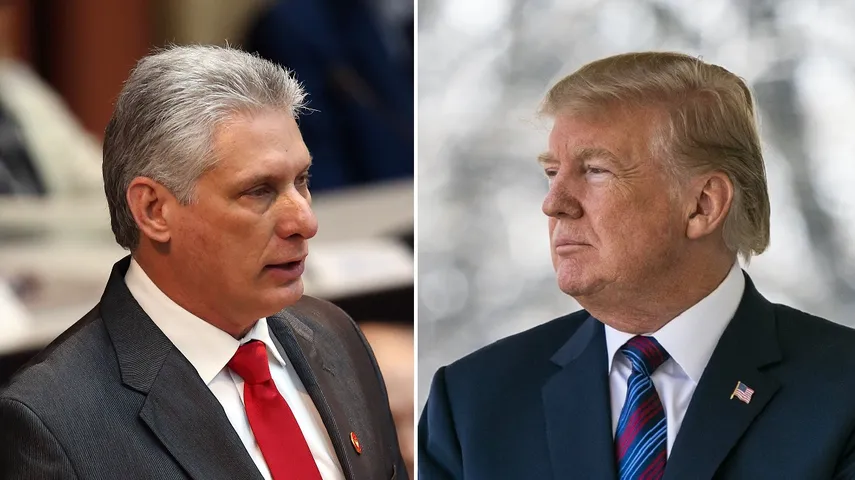
His statements contrast with those made in recent days by U.S. President Donald Trump, who has repeatedly said that his administration is negotiating with the Cuban government, even at a high level.
“Cuba has the legal and moral high ground in the face of the oil siege, and is willing to sit down for talks with the United States. And the United States government knows it. We have told them directly; we have said it publicly,” he said.
De Cossio warned that “there must be a mutual willingness to ensure and design a dialogue that is serious, constructive, responsible and respectful of the sovereign equality of both states.”
Neither reforms nor prisoners.
He also outlined the limits of the subjects that could be addressed in those potential negotiations, ruling out political and economic reforms as well as the release of prisoners on the island, as has happened in Venezuela.
Regarding possible political or economic reforms, he said Cuba has “the same limitation” that Washington would have in discussing “the United States Constitution” with Havana, or “the raids” against migrants taking place “in Minneapolis and other cities.”
On prisoners, he was categorical: “We see no reason; we do not see what connection one issue (the oil blockade) has with the other (prisoners). We have no intention of discussing that; it is not part of bilateral dialogue between two countries.”
Asked whether a figure like Venezuela’s acting president, Delcy Rodríguez, could emerge in Cuba, De Cossio flatly declined to comment on that analogy.
“If the assumption is that there are divisions within the Cuban government, divisions within the political forces in Cuba, and a willingness by a small group to surrender Cuba’s sovereign rights — our country’s prerogative — and capitulate to pressure and the United States’ unjustified and immoral aggression… that is a mistaken interpretation,” he asserted.
Limited options
In this context, De Cossio acknowledged that his country has “limited options” and said a contingency plan would be communicated to the population “in the coming days”: “a process of reorganization” that will be “very difficult” for the population.
“We have limited options, and we also need to reorganize the country, which means it will take a great deal of work and require considerable creativity. A reorganization process that we have anticipated (…) and have been preparing. It is not simple; it is difficult for the government’s management and very difficult for the population as a whole,” he said.
Meanwhile, the diplomat explained, the country is “preparing for defense,” to “resist a military attack.” The government’s responsibility toward its citizens, he argued, is “to defend them as Cubans, not as subjects of the United States.”
“The United States government should know that a military attack on Cuba is not simple, despite the absolutely asymmetrical superiority the United States has over Cuba (…). But they would have to ask themselves what the goal is: to bomb and destroy Cuba and leave everything a wasteland, or to try to put soldiers in Cuba and wage a war here against the Cuban people,” he warned.
The Cuban government’s hope, he continued, is that Washington will “search its conscience,” “understand the danger” of extreme military action on the island and “not listen to some of the politicians who have built careers and profited through hostile conduct against Cuba.”